In this guide
A delivery career is not defined only by the time behind the wheel. The assignment may include product work before and after the journey, communication at receiving locations and records that help resolve exceptions. To judge the work accurately, read those responsibilities alongside the license requirement.
The Chino Driver I posting describes deliveries to restaurant locations and satellite warehouses, product rotation, material-handling duties and some warehouse tasks. It also specifies Class A licensing, prior CDL delivery experience and manual-transmission requirements. These are facts about that requisition as checked on October 4, 2026, not a description of every driving job at the company.
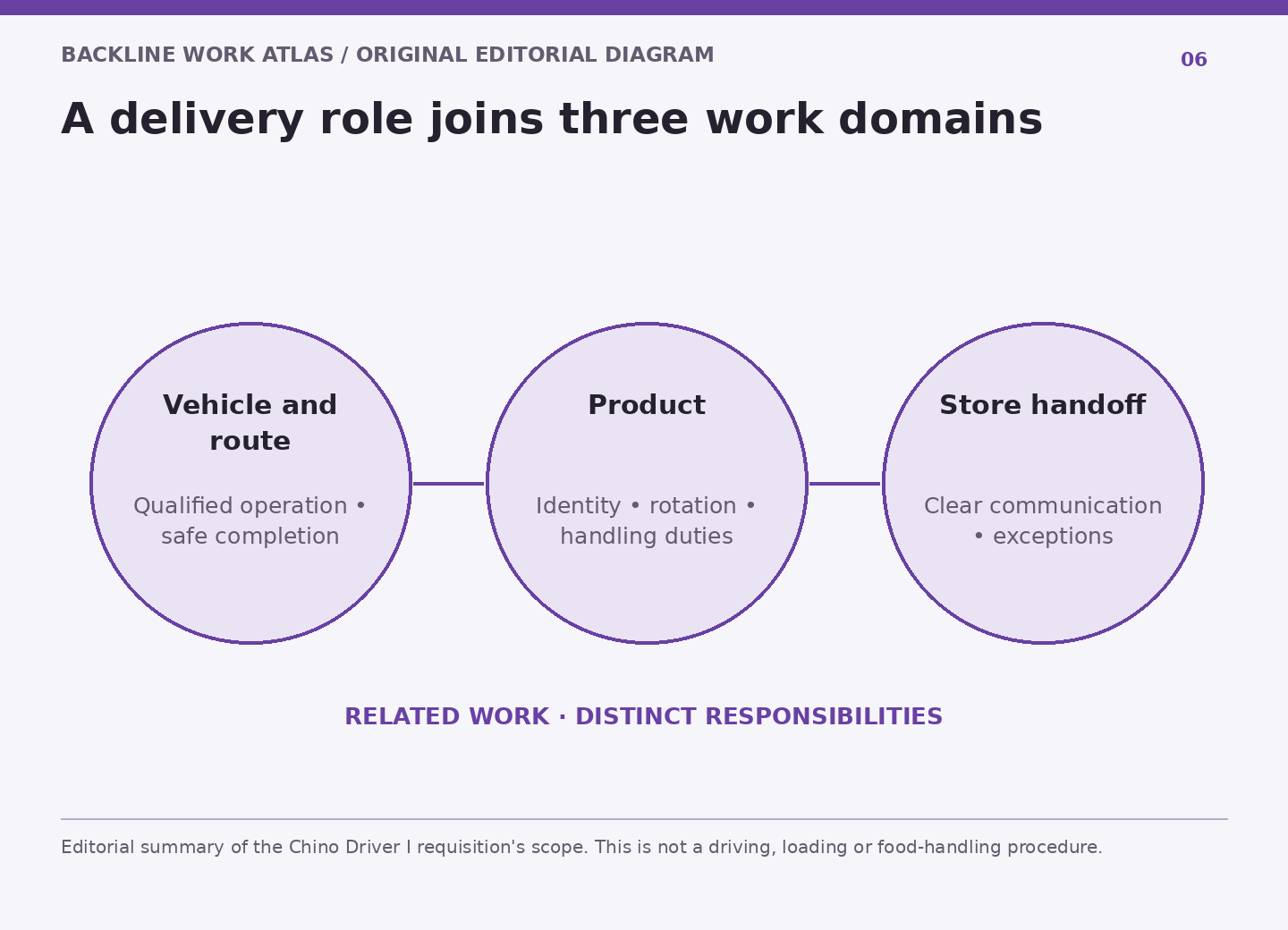
Three work domains meet in one assignment
The first domain is qualified vehicle operation. The second is the product and its assigned handling responsibilities. The third is communication with the receiving location. A reader who considers only the first may miss a substantial part of the assignment.
This article does not provide driving, loading, unloading, lift-gate, pallet-jack or product-rotation instructions. Those require appropriate qualification, training and employer procedures. The career exercise here concerns the information that lets people understand a delivery’s status without guessing.
Think of a handoff as a claim that another person can rely on. “Delivered” may be too broad if a portion remains unresolved. “Arrived” describes a different event from “received.” “Expected” describes something that has not necessarily happened. Clear status words make coordination possible.
A fictional stop with an incomplete handoff
Imagine a community exhibition receiving twelve cartons of printed programs. A practice route sheet lists twelve, but the receiving note records ten. The vehicle has arrived on time. Has the delivery succeeded? The answer depends on which output you are assessing.
The arrival target may have been met while the quantity question remains open. A useful practice report would keep those facts separate: “Arrival recorded at the planned time. Receiving record shows ten cartons against a twelve-carton reference. Status of the remaining two requires clarification.” It should not invent the reason or mark the entire task complete.
Now change the exercise so that twelve cartons were received but two belong to a later event. Again, count alone does not settle the handoff. The record needs the relevant destination or request reference. These are information problems, not an invitation to decide how a real driver should handle goods.
Service communication can be precise without being confrontational
An effective exception note gives the next person something answerable. “Your count is wrong” assigns blame. “The receiving note and dispatch practice sheet use different carton totals; which current reference should we compare?” identifies a discrepancy.
The difference matters because delivery work joins people who may be focused on different immediate tasks. A receiver may know what was accepted. A warehouse contact may know how an order was assembled. A planner may know whether the request changed. A clear question helps the relevant person contribute without assuming their answer.
For practice, write a short message with four fields: reference, observed status, unresolved difference and requested clarification. Leave out invented company names, private route information and unnecessary personal details. The objective is a reliable handoff, not a dramatic incident story.
Ask about the full assignment
When discussing an actual role, ask what work happens before departure, at a stop and after the route. Ask which equipment is involved and how training and evaluation are handled. Ask how exceptions are communicated through the employer’s process. These questions clarify the work without asking for confidential operating details.
The Chino posting also describes a rotating four-night arrangement and weekend and holiday availability. Recheck its current wording for the actual opening you consider. Do not assume a familiar geographic area means a conventional daytime schedule, or that a listed route region establishes the duration of every workday.
A role-specific question is stronger than a broad request for “a typical day.” For example: “How much of this assignment’s training concerns receiving-site product work compared with driving?” The employer may answer differently by location or assignment, and that difference can materially affect preparation.
Separate current eligibility from future interest
Someone without the stated license or experience can still research the career, but should not treat curiosity as current eligibility. Likewise, a warehouse posting that mentions potential driver development does not override the requirements of a separate Driver I requisition.
The warehouse-to-CDL guide examines that distinction. It separates a possible development opportunity from a guaranteed path and identifies the questions a real training arrangement would need to answer.
For now, complete a simple domain map. List the vehicle qualifications, product responsibilities and communication outputs explicitly stated in the posting. Mark unanswered questions rather than filling them with assumptions. That map gives you a concrete way to understand the assignment before comparing it with other forms of logistics work.
Sources and scope
Public sources checked October 4, 2026. Requisitions are snapshots, not continuing availability guarantees. Cases and practice artifacts are fictional.