In this guide
- Restaurant equipment service begins with a service boundary
- Plant refrigeration requires its own depth
- Parts work supports readiness without performing the repair
- National occupation labels help, but do not settle the match
- A hypothetical service problem reveals three outputs
- Build a preparation map with three separate columns
- Treat safety knowledge as a boundary, not a demonstration challenge
- Sources and scope
“Maintenance” is too broad a word to choose a career by. It can describe work on restaurant equipment, industrial refrigeration, a building or the parts that make scheduled work possible. The asset being supported changes the knowledge, hazards, tools, work setting and evidence of competence a role requires.
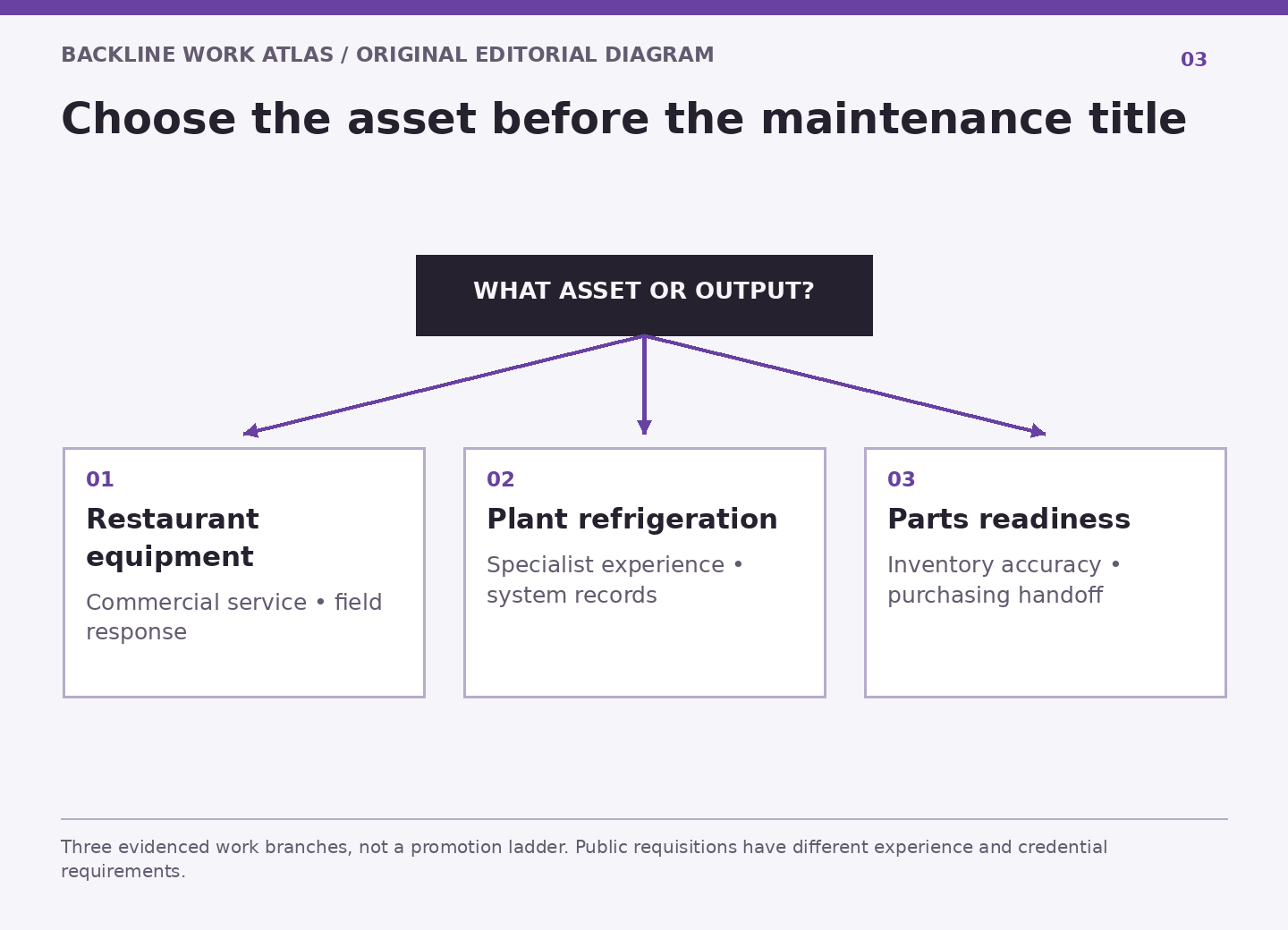
Three public In-N-Out requisitions make the difference concrete: a shop service technician, an ammonia refrigeration technician and a maintenance inventory clerk. This guide compares their work outputs. It does not rank them, turn them into a promotion ladder or suggest that experience in one automatically qualifies a person for another.
Restaurant equipment service begins with a service boundary
The Chino Service Technician I posting names restaurant equipment across refrigeration, air conditioning, cooking equipment and other commercial systems. It requires EPA and HVAC certification and describes commercial maintenance and electrical experience. The Roman numeral in the title therefore should not be read as a promise of an untrained entry route.
The output to explore is a service result that can be understood by the people relying on the equipment. In a career discussion, useful questions concern the range of assets, how work is assigned, when a specialist is needed and what records accompany completion. None requires an applicant to open equipment or attempt a repair.
A person who enjoys varied locations and changing service requests may find this branch interesting. Someone seeking a single predictable asset or a fixed daily task may want more information before assuming the title fits. That is a comparison of work preferences with a described role, not a prediction about any particular worker’s ability.
Plant refrigeration requires its own depth
The Lathrop Ammonia Maintenance Technician Level 2 posting concerns a specific industrial system. It names preventive work, system checks and maintenance records, and asks for substantial related experience plus particular certification language. The useful conclusion is that this is a specialist branch with its own preparation requirements.
A refrigerator in a home, a restaurant cooling unit and an industrial ammonia system should not be treated as interchangeable learning projects. Familiarity with one does not establish competence with another. The role-specific guide on ammonia refrigeration preparation explains how to read the requirement structure while keeping technical procedures outside this publication.
At this level, documentation also becomes part of the work product. A record can connect an observation to the work performed, parts used and remaining follow-up. A person researching the occupation can practice writing clear, fictional records. They cannot reproduce a real facility’s technical assessment or sign-off without the appropriate authority.
Parts work supports readiness without performing the repair
The Lancaster maintenance inventory clerk requisition connects receiving, stock accuracy, replenishment and parts requests with maintenance and purchasing. That is a different output: making the correct material available and traceable for the people authorized to use it.
This branch may interest someone who likes technical vocabulary, organized records and solving availability problems but is not currently qualified to diagnose equipment. That does not make the role a substitute credential for repair work. It is a distinct inventory occupation, with its own required experience and knowledge.
Consider the difference between “there are six items on the shelf” and “the correct approved part is available for this scheduled task.” The second claim needs more information. A clerk can support that information without becoming the person who decides whether an alternative component is technically suitable. Our parts-readiness exercise makes that distinction visible.
National occupation labels help, but do not settle the match
The BLS industrial-maintenance profile distinguishes machinery mechanics, machinery maintenance workers and millwrights, and describes training pathways across the wider labor market. These categories are a vocabulary aid. They are not a promise that an employer uses the same divisions or offers a particular apprenticeship.
Read a national profile to discover questions you had not considered. Does the work involve installation, diagnosis, scheduled maintenance or a mix? Is the knowledge tied to a particular kind of equipment? How much of the learning occurs through supervised practice? Then return to the exact requisition to establish the employer’s stated requirements.
Avoid using a broad occupational description to soften a specific requirement. If a posting requires a credential, a general statement that many workers learn on the job does not remove it. Conversely, a preferred qualification is not automatically mandatory merely because it sounds impressive. Keep the wording and uncertainty intact.
A hypothetical service problem reveals three outputs
Imagine a fictional exhibition company with a display unit that is not available for the next event. No real machine or repair is involved in this exercise. The service note says only “broken again.” The stock record says a replacement component exists. The event coordinator says the display is needed tomorrow.
Three people can contribute different outputs. The coordinator can state the business need and timing. A qualified technician would determine the technical condition within the organization’s procedures. An inventory worker can verify the identity, location and commitment status of the recorded component. The three activities are related, but one cannot substitute for another.
Improve the exercise by adding one ambiguity: the component on the shelf is already assigned to another event. The technical diagnosis may be correct and the count may be correct, yet the job is not ready. This exposes the value of coordination without inventing a mechanical failure or teaching a repair.
Now add a second ambiguity: the note names the wrong asset. An excellent inventory response could still support the wrong task. The lesson is that reliable maintenance work depends on a chain of correct references. Technical depth matters, but clear identification and honest records also matter.
Build a preparation map with three separate columns
Use one page with columns headed knowledge, supervised practice and authorization. Under knowledge, list concepts you can responsibly study through a course or public resource. Under supervised practice, record the activities that need an instructor, suitable equipment and an appropriate setting. Under authorization, record what a future employer would need to determine before you could perform a real task.
This prevents a common mistake: treating study as proof of practical competence. It also helps you compare training options. A course may teach useful theory without including the supervised experience a specific role expects. A certificate may document completion without establishing competence on every system named in a posting.
For a real training purchase, check the provider, curriculum, assessment, costs and credential recognition before committing. This article does not recommend a school or guarantee that an employer will accept a program. A job posting can tell you what to investigate; it cannot promise an individual outcome.
Treat safety knowledge as a boundary, not a demonstration challenge
OSHA’s hazardous-energy overview makes clear that maintenance work can involve dangerous stored energy and unexpected startup. Reading about that risk is a reason to insist on proper training and procedures, not an invitation to attempt a test at home or in a workplace.
Do not use an application exercise to open an electrical enclosure, bypass a guard, adjust a refrigeration system or diagnose unfamiliar machinery. A safe preparation sample might instead compare three public descriptions, define the assets each covers and explain which requirements remain unmet. It can also include a fictional service observation that avoids unsupported diagnoses.
Finish with an asset-specific next question. “How do I get into maintenance?” is broad. “Which recognized preparation and commercial experience would support this restaurant-equipment role?” is answerable. So is “What inventory-system work would prepare me for parts readiness?” The sharper question respects both the opportunity and the limits of your current experience.
Sources and scope
Public sources checked October 4, 2026. Job pages are dated research snapshots; availability and requirements can change. Exercises are editorial examples.
- Service Technician I (Shop Technician), Chino, CA (8838)
- Ammonia Maintenance Technician Level 2, Lathrop, CA (8527)
- Meat Department Maintenance Inventory Clerk, Lancaster, TX (8806)
- BLS: Industrial Machinery Mechanics, Machinery Maintenance Workers, and Millwrights
- OSHA: Control of Hazardous Energy (Lockout/Tagout)