In this guide
- Four outputs supported by separate postings
- Production work: consistency under changing conditions
- Quality work: a useful observation is reproducible
- Sanitation work: completion has a defined meaning
- Maintenance work: a different kind of uncertainty
- Coordination becomes its own responsibility
- Choose a learning route from the work, not the prestige of the title
- Sources and scope
A finished food product depends on several kinds of work that can look similar from a distance. Someone performs an assigned production task. Someone checks a condition against a defined standard. Someone completes sanitation work. Someone maintains equipment. All may be present around the same process, but they do not necessarily have the same responsibility or authority.
For a reader exploring In-N-Out employment beyond restaurant-facing work, the distinction matters more than a list of department names. The useful career question is: which output do you want to be responsible for, and what training allows you to produce it reliably? Public postings provide enough evidence to explore that question without inventing a plant’s internal sequence or teaching a hazardous procedure.
Four outputs supported by separate postings
The Spread Room Operator requisition combines production, packaging and sanitation-related duties. The Meat Department General Helper requisition connects receipt and inventory work with production support. These are examples of hands-on work whose exact task mix depends on the assignment; the titles alone do not describe a complete day.
The Quality Control Technician – Spread posting emphasizes monitoring, sampling and documentation, with corrective-action responsibilities that can include stopping production. The Lathrop Sanitation Technician posting describes cleaning and sanitizing processing equipment, including chemical-concentration records. Those are employer-published responsibilities for those specific roles. They are not permission for every worker to make the same decisions.
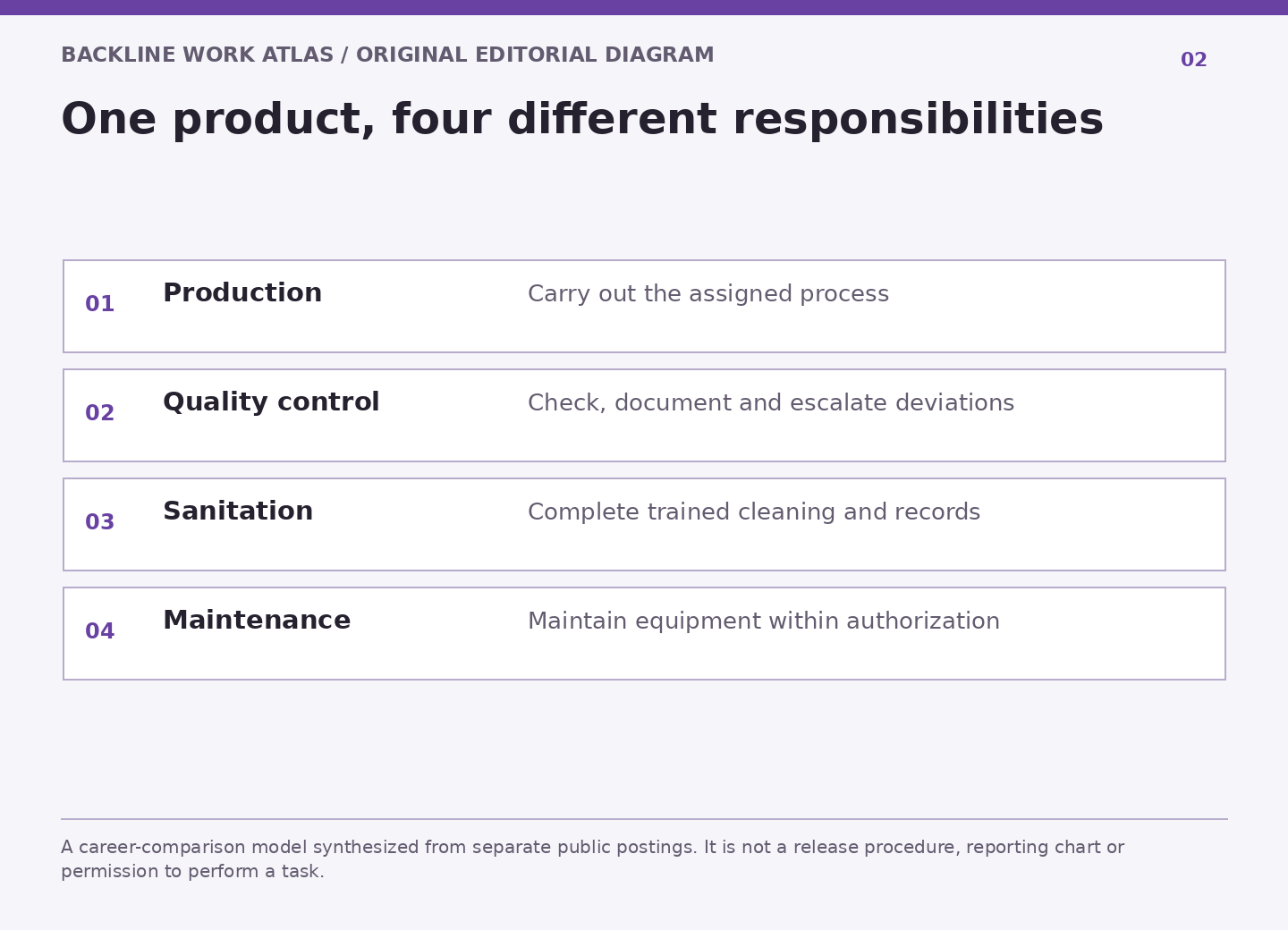
The diagram is deliberately parallel rather than a step-by-step flow. Public descriptions show distinct responsibilities, but they do not establish the exact order in which a site authorizes maintenance, cleaning, verification and production restart. That missing sequence is important. A career article should not make it up merely because a neat diagram would be easier to draw.
Production work: consistency under changing conditions
In an original classroom exercise, imagine assembling sealed, empty display boxes for a school exhibition. The agreed output is a box with the correct label and contents. After a material change, the printed work card still names the earlier label. A production-minded learner should notice that the instruction and supplied material no longer match.
The exercise does not reward improvising a new label standard. It rewards identifying the mismatch and seeking the designated clarification. The broader career insight is that consistency requires attention, not passive repetition. Repeating a task can make a small change harder to notice precisely because most of the work looks familiar.
To explore whether that appeals to you, ask what kinds of repetition you find satisfying, how you notice changes and what helps you preserve concentration. Those are learning questions. They are not a self-assessment of fitness for cold rooms, heavy lifting or machine operation. The employer’s training and the actual task environment determine those matters.
Quality work: a useful observation is reproducible
Now assign another learner to inspect the display boxes against the exercise specification. “These look fine” is weak evidence. “All six sampled boxes use label revision B; the specification calls for revision C” is more useful because another person can reproduce the comparison.
The difference is not that one learner cares about quality and another does not. It is that the checking assignment requires an explicit reference, an observation and a traceable result. An observation without a reference can become opinion. A reference without a recorded observation can leave the next person unable to verify what happened.
This distinction makes quality-control careers attractive to people who enjoy precise language, evidence and unresolved questions. It also places limits on personal judgment. A practice exercise can teach clear documentation; it cannot teach an applicant the company’s actual product-disposition rules or confer authority to release a product.
Sanitation work: completion has a defined meaning
Return to the harmless classroom example. One person says the display table is clean because no scraps are visible. Another says the reset is complete only when the agreed checklist is finished and the materials for the next group are accounted for. The disagreement concerns the definition of completion.
In real food-processing sanitation, the stakes and required controls are very different. The public job description establishes that prescribed procedures and records matter. It does not publish a complete sanitation program. Do not infer concentrations, contact times, chemical combinations or equipment methods from a career article, and do not test them yourself.
The career exploration question is whether you are interested in careful procedural work whose result may be less visible to an outside observer than finished production. The record is not decorative paperwork; it can communicate what was done and what still needs attention. The separate sanitation handover guide examines that communication boundary without providing cleaning instructions.
Maintenance work: a different kind of uncertainty
A production worker may observe that an assigned process is not behaving as expected. A maintenance specialist may be responsible for diagnosis and repair. These are different activities. Reporting a symptom accurately does not require guessing the failed component, and an unqualified person should not perform an intervention to make the report sound more technical.
OSHA’s hazardous-energy overview explains why servicing can expose workers to unexpected startup or stored energy. The useful preparation boundary is therefore explicit: learn how to describe an observation, and obtain the employer’s role-specific training before any hands-on task. This publication does not provide lockout instructions, repair sequences or a restart checklist.
A strong observation might distinguish when the issue was noticed, what was visible from an authorized position and what work was affected. It should not claim a diagnosis that has not been made. See writing a useful service observation for an entirely fictional, non-operating practice case.
Coordination becomes its own responsibility
The Quality Control Supervisor posting names collaboration with production, maintenance, sanitation and laboratory management. It also includes training, program documentation and analysis. This demonstrates a coordination role in the public record, but not a universal reporting chart for every facility.
The career difference between doing a check and leading a program is substantial. At program level, a person may need to understand whether several individually completed activities produce a reliable overall result. A missing definition, inconsistent record or unclear responsibility can matter even when every participant worked hard.
Use a paper exercise to explore that difference. Give four learners four different definitions of “ready.” Ask them to identify the disagreement before any imaginary work proceeds. The facilitator’s output is a shared list of unresolved decisions and who would need to answer them. It is not a new food-safety policy.
Choose a learning route from the work, not the prestige of the title
If you like producing consistent physical output, start with the operator task-and-shift guide. If you are drawn to comparing evidence with a specification, read the quality technician guide. If you like explaining a task until another person can demonstrate it, explore production training.
For each route, write three short statements: the output you understand, the boundary you would not cross without training, and the next fact you need from an actual requisition. This creates a focused learning plan without turning curiosity into an invented credential. You can be interested in a work family while still being far from its current qualification requirements. Recognizing that distance is useful career research, not a reason to blur the requirements.
Sources and scope
Public sources checked October 4, 2026. Job pages are dated research snapshots; availability and requirements can change. Exercises are editorial examples.