In this guide
A warehouse order can be physically complete and still be wrong. The product might be correct but the unit misunderstood. The quantity might match while the destination does not. Work behind restaurant service therefore asks for more than willingness to move boxes. It asks a person to preserve meaning while goods move between people, places and records.
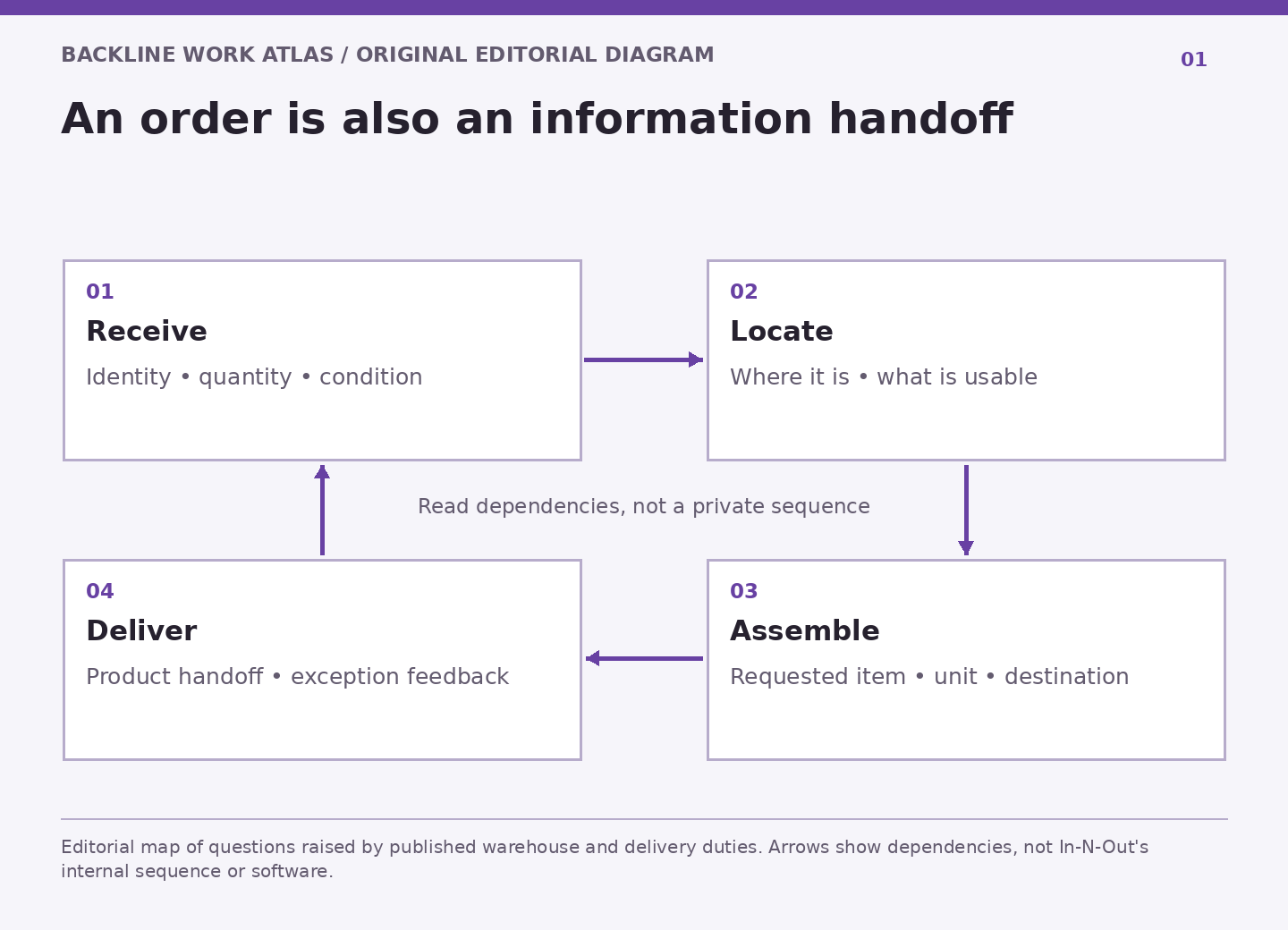
For someone searching for an “innout associate” role beyond the counter, that is a useful starting point. This guide studies warehouse work through its outputs and handoffs, using a public Lathrop requisition as evidence. The sequence below is an editorial learning model, not a tour of an In-N-Out warehouse or a description of its private operating procedures.
What the public posting actually establishes
The Lathrop Warehouse Worker posting describes order pulling, keeping products organized and in rotation, and receiving, storing and distributing goods. It also names powered material-handling equipment. The Chino Driver I posting includes product delivery and rotation as well as some warehouse work. Together, these two requisitions establish that movement and product accuracy cross job boundaries. They do not reveal which person approves every exception, how an internal screen works or what a particular building’s layout looks like.
The national BLS material-mover profile also includes recording goods and working alongside other material-handling roles. That is useful occupational context, not a replacement for an employer’s exact description. A national category cannot tell you the local assignment, the equipment you would be authorized to use or the training plan for a particular opening.
Start with the output the next person needs
A helpful way to explore this career is to name the finished work without naming the tool. “I used a scanner” tells little. “The next person could identify the item, quantity and intended destination without guessing” describes an output. A tool may support that outcome, but possession of the tool is not the outcome itself.
Use four questions to follow an imaginary order. At receipt, what has actually arrived? In storage, what can be found and used? During assembly, what was requested and what has been selected? At the handoff, what is complete and what remains unresolved? These questions apply to a classroom simulation with paper cards. They do not require access to a real loading dock, inventory system or company document.
The questions also reveal different kinds of satisfaction. Some people enjoy producing an orderly, visible result. Others are drawn to explaining why a record and a physical count disagree. Others like coordinating the boundary between an accurate order and a successful delivery. Those interests can lead you toward different articles and training questions without pretending that one is a promotion step above another.
A worked order with a deliberately small error
Imagine a fictional practice warehouse preparing supplies for a community event. The request says twelve cases of paper cups. A shelf card lists twelve sleeves, with ten sleeves in a case. A learner writes “12” in the quantity field and marks the request complete. The number is correct only as a number. Its meaning is wrong.
The useful response in this exercise is to identify the unit mismatch before deciding what should move. A practice note might say: “Request unit: case. Shelf count unit: sleeve. Conversion supplied by exercise: ten sleeves per case. Quantity cannot be compared until units match.” The point is disciplined reading, not speed or a particular warehouse procedure.
Now change the scenario. The requested twelve cases are present, but two are labeled for another destination in the exercise. The quantity alone still cannot establish completion. You need a destination check. Finally, suppose every item matches, but the record has no time or named recipient. The next learner cannot tell whether the handoff happened or was only planned. Each variation exposes a different information failure.
This is why a useful practice artifact contains separate fields for item, unit, quantity, destination and status. Combining everything into a single free-text note makes it easy to skip an essential fact. Separating the fields makes uncertainty visible without requiring you to invent a company form.
Exceptions are part of the job question
A discrepancy is not automatically evidence that somebody performed badly. The source request may have changed. A unit may be ambiguous. Two records may refer to different times. In career exploration, the important habit is to distinguish observation from explanation: “The exercise count is ten cases” is an observation; “someone forgot two cases” is an unverified explanation.
Practice writing the smallest complete exception report. Include the expected state, observed state, unit, relevant reference and unresolved question. Avoid assigning blame or supplying an unauthorized correction. In a real workplace, escalation routes and correction authority come from the employer. An applicant’s independent exercise should demonstrate clear thinking, not imitate access to an internal approval system.
Our receiving discrepancy exercise develops this skill further. It focuses on reconciling two descriptions of the same delivery, rather than teaching how to accept or reject actual food or operate receiving equipment.
Physical work and information work belong in the same comparison
A person may like the logic of inventory but dislike the setting in which a particular role performs it. Conversely, someone may enjoy active work and underestimate the concentration required for repetitive checking. Neither response determines suitability by itself. Read the complete local posting, including physical demands and schedule, then ask what those statements mean for the assigned work.
The Lathrop requisition describes a rotating four-day schedule and specific physical requirements. Those details are local to that posting, not a universal warehouse arrangement. A sensible role discussion asks about the actual task mix, the training process, the equipment used and how the workday is organized. It does not convert a public lifting statement into a self-directed lifting test.
Powered equipment deserves a separate boundary. OSHA’s training guidance requires appropriate instruction and workplace evaluation of operator competence. A general course or prior experience does not, by itself, authorize someone to use a different employer’s equipment in a new setting. Use public research to prepare questions, never to practice on machinery without authorization and qualified supervision.
Build a preparation sample that stays safe
Create a small fictional order board with six items, two destinations and mixed units. Include one intentional discrepancy. Produce a clean final record and a separate exception note. Then have another person read the materials without your explanation. Can they determine what is known, what changed and what remains open?
Evaluate the sample on clarity rather than appearance. A simple page with accurate definitions is more useful than an elaborate dashboard whose totals cannot be traced. Keep the exercise modest enough that every value can be checked manually. Label it as practice and use invented products and locations, not workplace records taken from a current or former employer.
Finish by choosing one next question. If the physical movement interests you, investigate the actual equipment-training expectations. If the discrepancies interest you, read about maintenance-parts inventory. If the receiving handoff interests you, explore delivery accountability. The goal is a sharper understanding of the work you want to learn, not a claim that a fictional exercise qualifies you for a job.
Sources and scope
Public sources checked October 4, 2026. Job pages are dated research snapshots; availability and requirements can change. Exercises are editorial examples.