In this guide
A maintenance team can know what work is needed and still be unable to begin because the right part is not ready. “We have one” may mean a record contains one, a shelf contains one, or one is available for this particular job. Those are different claims.
The Lancaster Meat Department Maintenance Inventory Clerk posting makes this work visible. It includes parts receipt and issue, inventory counts, replenishment requests and coordination with purchasing and maintenance. The role supports readiness through accurate information and organized material. It does not give an inventory worker automatic authority to choose a substitute component or perform a repair.
Define the status before trusting the number
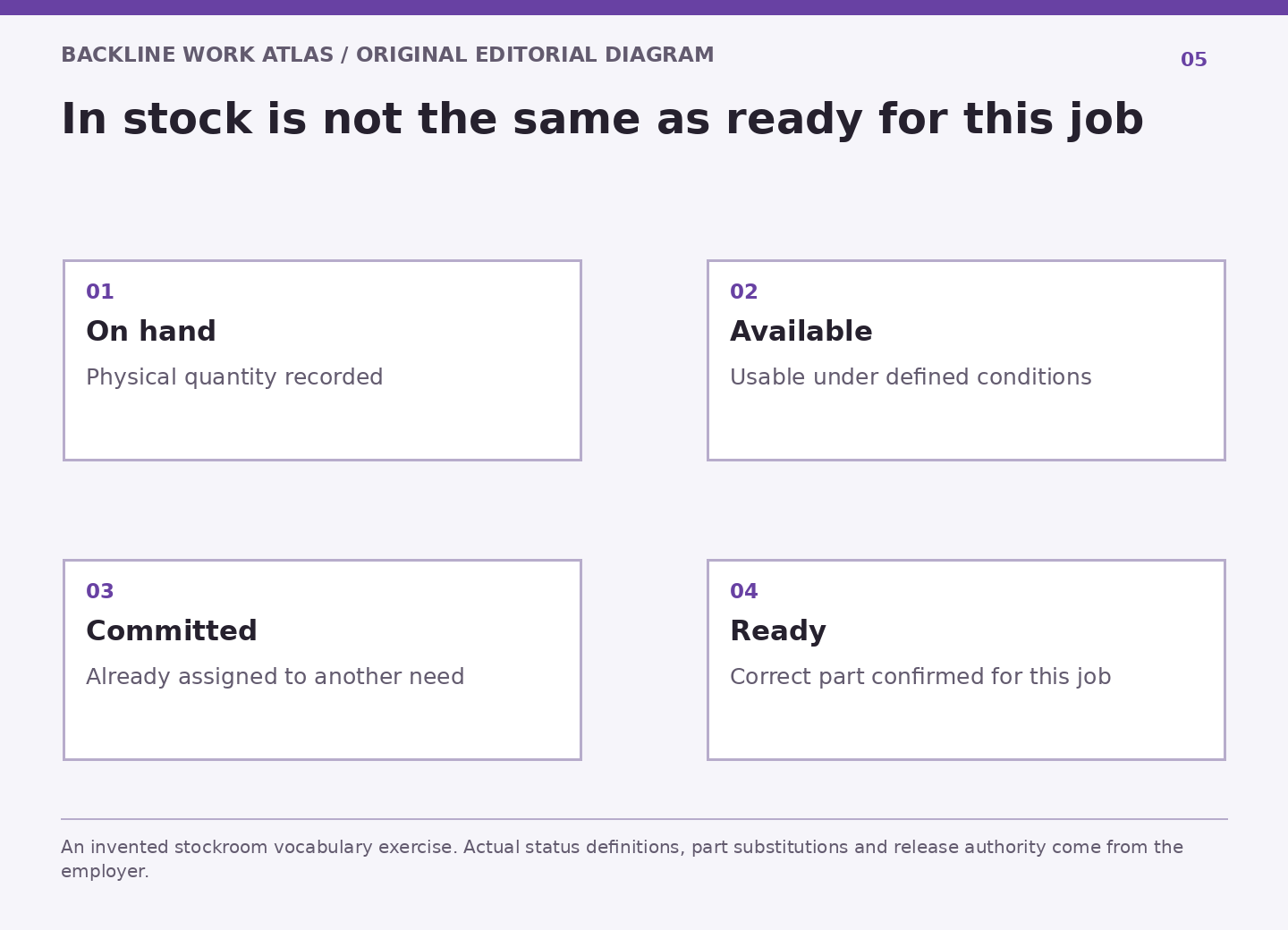
For an original learning exercise, distinguish four states. On hand means physically recorded at the location. Available means usable under the exercise’s stated rules. Committed means assigned to another need. Ready means the correct item has been confirmed for the specific task being planned.
These are editorial definitions, not In-N-Out’s internal status codes. Their value is that they prevent one number from answering four different questions. A live employer may use different terms and systems, which you would need to learn through authorized training.
Imagine a fictional museum workshop with three replacement display hinges on a shelf. One is reserved for a scheduled exhibit. One has an unresolved identity label. One is confirmed and uncommitted. The physical count is three, but the exercise offers only one clearly ready item for a new request. The difference is not an arithmetic mistake. It is a status distinction.
A part description is not a compatibility decision
Now suppose a request names hinge model H-20, while the uncommitted item is marked H-20A. They look similar on the paper exercise. A learner should not assume the suffix is unimportant. The appropriate output is a clear question about identity or approved compatibility.
This distinction matters in career exploration because inventory work rewards technical curiosity alongside restraint. You can learn to recognize the fields that require attention without claiming engineering authority. Recording that two identifiers differ is useful. Declaring them interchangeable without an approved basis is a different, unsupported decision.
A good practice record therefore includes the requested identifier, observed identifier, relevant reference and unresolved question. Do not borrow actual part numbers, maintenance records or asset photographs from a workplace to make the exercise seem more authentic. Invented data is enough to reveal the reasoning.
Replenishment joins the present to a future need
The public requisition refers to monitoring levels and generating replenishment requests. To understand that output, imagine the workshop expects to use two confirmed hinges next week. Only one is uncommitted. A count explains today’s state; a replenishment question considers an upcoming need and the time required to obtain more.
Do not turn that into an invented company reorder rule. Minimum and maximum levels, approved suppliers and ordering authority are operational decisions. A practice exercise should state its own assumptions explicitly: “For this fictional case only, the next exhibit needs two units and the supplier’s confirmed arrival is Wednesday.” Then test what changes if the arrival becomes Friday.
The useful skill is showing the consequence of a changed assumption. A beautifully organized shelf does not resolve a missed delivery date. A purchasing update does not resolve an uncertain part identity. The clerk’s communication can help the appropriate people see which problem remains.
Count accuracy and service quality reinforce each other
A stockroom serves other workers. Fast responses are useful only when the information is reliable. “I can see three” is less helpful than “Three are recorded; one is committed, one needs identification and one is available under this exercise.” The second response may be longer, but it prevents the requester from planning around an unusable number.
Equally, a technically correct record can be hard to use if it lacks a clear next step. State what you can answer and what you need from the requester. Ask for a missing reference rather than assuming the requester’s technical intent.
The inventory-clerk posting asks for prior inventory-control or parts-management experience and identifies software and industrial-environment exposure among its qualifications and preferences. Read those requirements directly. A small exercise helps you explore the work; it is not a substitute for the experience the actual opening requires.
Produce a one-page readiness board
Build a fictional board with six items and three upcoming tasks. For each item, record identity, physical count, commitments, unresolved conditions and the task that needs it. Include one mismatch and one delayed arrival. Write two short handoff notes: one to a purchasing role and one to a qualified maintenance role.
The purchasing note should ask about an order or arrival. The maintenance note should ask about identity or the task requirement. If both notes ask the same vague question, refine them until each recipient can see why the question belongs to them.
You have finished the exercise when another reader can distinguish stock quantity from job readiness without asking you to narrate the board. That is a concrete preparation outcome for exploring parts work, and a useful companion to the broader maintenance career comparison.
Sources and scope
Public sources checked October 4, 2026. Requisitions are snapshots, not continuing availability guarantees. Cases and practice artifacts are fictional.