In this guide
A dashboard can display a precise number while concealing an imprecise definition. If one source records cartons and another records individual kits, adding the quantities without preserving their units creates a result that looks technical but cannot be trusted. Data engineering works on the foundations that make later analysis meaningful.
The In-N-Out Data Engineer III posting describes integrations, pipelines, curated datasets, quality controls and source-to-target documentation. It requires substantial experience and specified technical skills. This article uses a small synthetic example to explain the work output; it does not reproduce a company schema or imply that a practice project meets the role’s requirements.
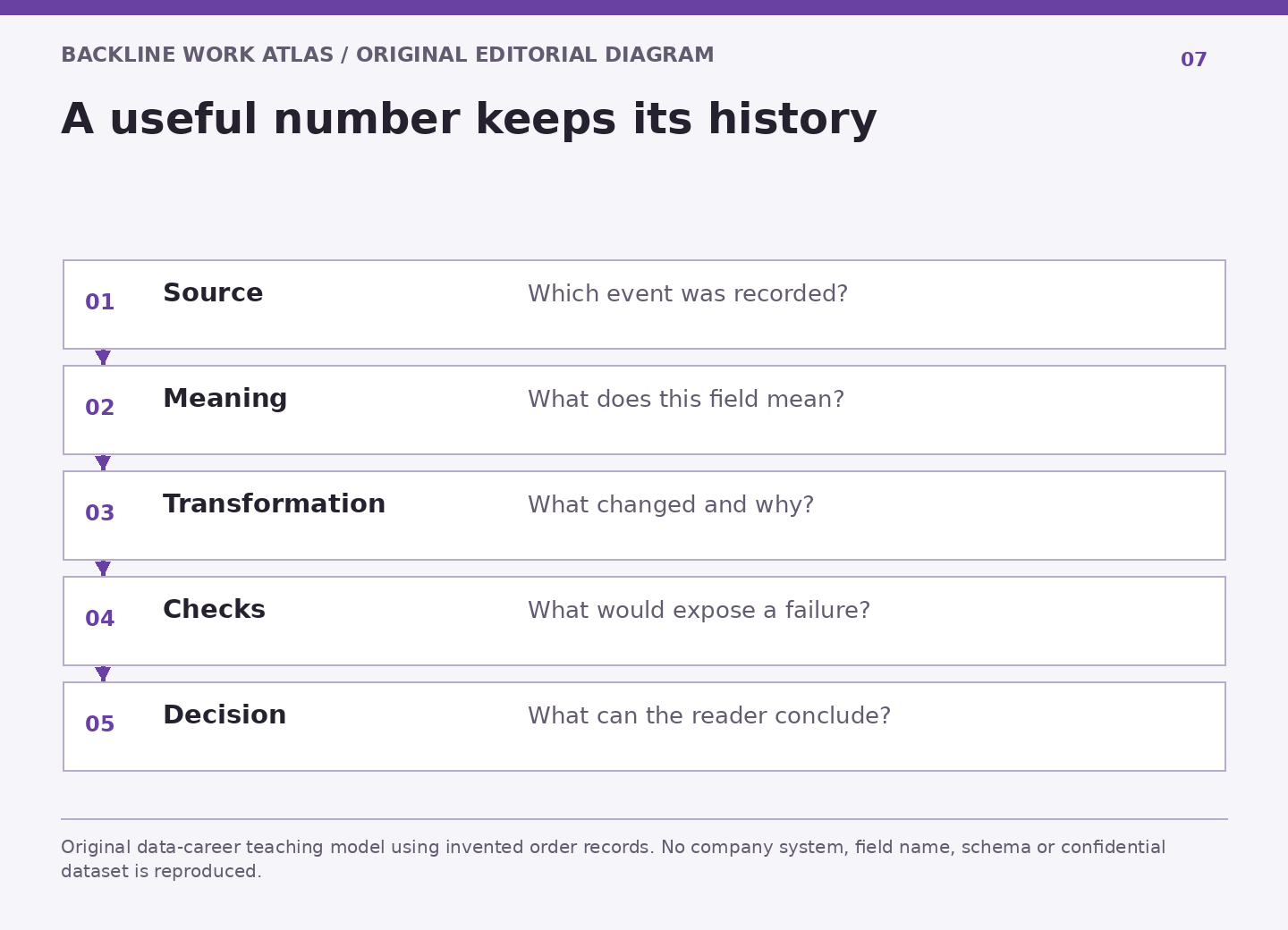
Define the event before the field
Imagine a fictional exhibition system with three records. Request A asks for ten kits. Request B asks for six cartons, each containing two kits. Request C asks for four kits but has no destination entered. All records are invented.
Before combining them, define what a row represents. Is it a request, a shipment or a received quantity? A request record does not prove delivery. Naming the event prevents an apparently reasonable dataset from answering the wrong business question.
Now define the fields: request identifier, requested quantity, unit, conversion basis, destination and record time. Avoid a generic column named “amount” when the value actually describes a count. Good field names reduce ambiguity, but a written definition is still needed when a business term can mean several things.
Preserve the raw meaning through the transformation
For the exercise, convert request B’s six cartons into twelve kits using the explicitly supplied two-kits-per-carton rule. The requested total becomes ten plus twelve plus four, or twenty-six kits. Keep the original quantity and unit alongside the normalized quantity so a reader can trace the conversion.
Do not assume every carton always contains two kits. That is an exercise-specific mapping. A real transformation needs an approved source for the conversion and a way to handle missing or changed definitions. A silent default can turn an unknown into a false fact.
The transformation note should say where each output comes from. “Normalized kits equals requested quantity multiplied by the defined unit conversion” is a useful start. Add what happens when the conversion is absent: flag the record for review in the exercise rather than guessing.
Missing is different from zero
Request C has no destination. It does not therefore belong to a destination named “zero,” and its requested quantity is not zero. Those are different kinds of missing information. A model that replaces every blank with the same default can make the data appear complete while losing the uncertainty.
Separate two questions. Can the total requested quantity be calculated under the stated assumptions? Can every request be allocated to a destination? In the exercise, the first answer is yes and the second is no. A useful dataset makes both statements possible.
This is a career-relevant habit: preserve enough meaning that downstream users can make a bounded conclusion. Data quality is not simply the absence of empty cells. It concerns whether the information is suitable for the question being asked.
Write checks that would catch your own mistake
Add four validation checks to the synthetic project. Each request identifier should have the defined uniqueness rule. Every quantity should carry a unit. Every normalized value should have a known conversion basis. Every destination-level result should show whether unassigned requests remain.
Now deliberately duplicate request A. A naïve total becomes thirty-six kits. The uniqueness check should reveal why the number changed. Remove the conversion for request B. The project should expose an unresolved mapping rather than retaining the earlier total without explanation.
These tests are original examples of validation logic. They do not disclose how In-N-Out validates data or what software it uses. The public posting names capabilities and preferences; a tool list is not proof of a specific internal implementation.
Documentation connects technical and business readers
Produce two explanations of the same project. The technical note describes the input fields, transformations and checks. The business note says: “Twenty-six kits were requested across three synthetic requests; one request lacks a destination, so destination totals are incomplete.”
Neither explanation should overstate the result. The data concerns requests, so it cannot establish what was shipped or received. The distinction may seem small, but it is exactly the kind of semantic boundary that makes reporting useful.
The observed Data Engineer III role emphasizes collaboration with technical and nontechnical stakeholders. This exercise shows why that matters without inventing the company’s meetings or team structure. A transformation can be technically correct and still require a business definition to settle its meaning.
Keep the project small, reproducible and private-data-free
Three to ten invented records are enough for a first learning artifact. Include a data dictionary, source-to-target map, expected results and a short limitation note. Another learner should be able to reproduce the result and identify the intentional failures.
Use no real employee, customer, supplier or operational data. Do not copy a schema from a workplace system or request access merely to make a portfolio look credible. Synthetic data is appropriate precisely because the quality of the reasoning can be inspected without exposing anyone’s records.
If you enjoy preserving meaning across transformations, data engineering deserves further study. If you prefer deciding whether the application lets a user enter the right information, the neighboring software-quality guide explores that different output.
Sources and scope
Public sources checked October 4, 2026. Requisitions are snapshots, not continuing availability guarantees. Examples and artifacts are original learning exercises.