In this guide
- Planning asks whether the business need is represented correctly
- Systems administration asks whether the service works reliably
- Data engineering asks whether meaning survives movement
- Software QA asks whether behavior meets the intended requirement
- One fictional order, four investigations
- The best practice artifact depends on the work family
- Read the experience level as carefully as the technology list
- Sources and scope
When a warehouse order looks wrong on a screen, “an IT problem” is only a starting guess. The source request may be wrong. A system interface may not have completed. A report may use a different definition of a unit. The software may behave incorrectly under a particular condition. Each possibility asks for different evidence and a different kind of work.
Public In-N-Out postings support a useful four-part comparison: materials planning, supply-chain systems administration, data engineering and software quality assurance. This guide uses their stated outputs to explore career direction. It does not describe the company’s actual technical architecture, incident process or private applications.
Planning asks whether the business need is represented correctly
The Materials Planner I requisition describes assessing store needs, checking orders, tracking warehouse levels and producing Excel reports. Its central career question is about supply continuity: does the plan reflect the need and the available material?
A spreadsheet can support that work, but the spreadsheet is not the whole job. An unexpected number may require clarification from a person who understands the request. A model can calculate perfectly from the wrong assumption. Someone must recognize when a business fact, rather than a formula, needs to be checked.
The BLS logisticians profile places supply coordination and forecasting in wider occupational context. That does not make every planning requisition equivalent to the national occupation. It helps explain why communication with other functions belongs alongside analytical skill.
Systems administration asks whether the service works reliably
The Supply Chain Systems Administrator I posting names administration, support, testing and documentation across enterprise supply-chain systems. It also names interface issues and collaboration with vendors and internal IT. The relevant output is reliable service and understandable technical state.
The named platform categories include ERP, WMS, TMS, MRP and EDI. In plain language, these refer to enterprise resource planning, warehouse management, transportation management, materials requirements planning and electronic data interchange. A posting’s list describes the scope of the role. It should not be treated as a verified diagram of every system the company currently runs.
A person drawn to this work may enjoy tracing where a request stopped, maintaining documentation and coordinating a resolution across technical boundaries. That is different from deciding how much a store should order. Both roles may discuss the same record, but they ask different questions about it.
Data engineering asks whether meaning survives movement
The Data Engineer III requisition describes pipelines, integrations, curated datasets and data-quality controls. It emphasizes documentation of mappings and transformations. That makes the output more specific than “a dashboard”: information that retains a defined meaning as it moves between sources and consumers.
Imagine that one fictional system records individual packages and another reports cases. If a transformation drops the unit, the resulting total can be numerically neat and operationally useless. A data engineer’s work may include preserving that distinction and making failures visible. This is an original teaching example, not a claim about an In-N-Out dataset.
This branch can appeal to someone who likes both programming and the patient work of defining terms. It also requires respect for confidentiality. Practice projects should use invented or properly licensed public data, never copied employee, customer, supplier or operational records from a real workplace.
Software QA asks whether behavior meets the intended requirement
The Senior Software QA Engineer posting describes test strategy, automation, defect management and collaboration across product and engineering. The output is evidence about software behavior and its risks, not merely a collection of automated clicks.
A test can pass because the expected result was wrong. A defect can be difficult to resolve because nobody recorded the conditions that produced it. Good quality work therefore combines requirements, controlled examples, observable results and clear communication. Senior work adds strategy and coordination across people and applications.
The exact software posting requires substantial prior QA experience. Interest in testing or success with a small practice project should not be presented as meeting that requirement. A practice project can help you decide whether the work appeals to you and what further learning would be needed.
One fictional order, four investigations
Use an invented order for forty display kits at a community exhibition. The request sheet says forty kits. The warehouse practice record says forty cartons, with two kits in each carton. The report shows eighty kits. A test application displays “40” without a unit. No real company systems or products are involved.
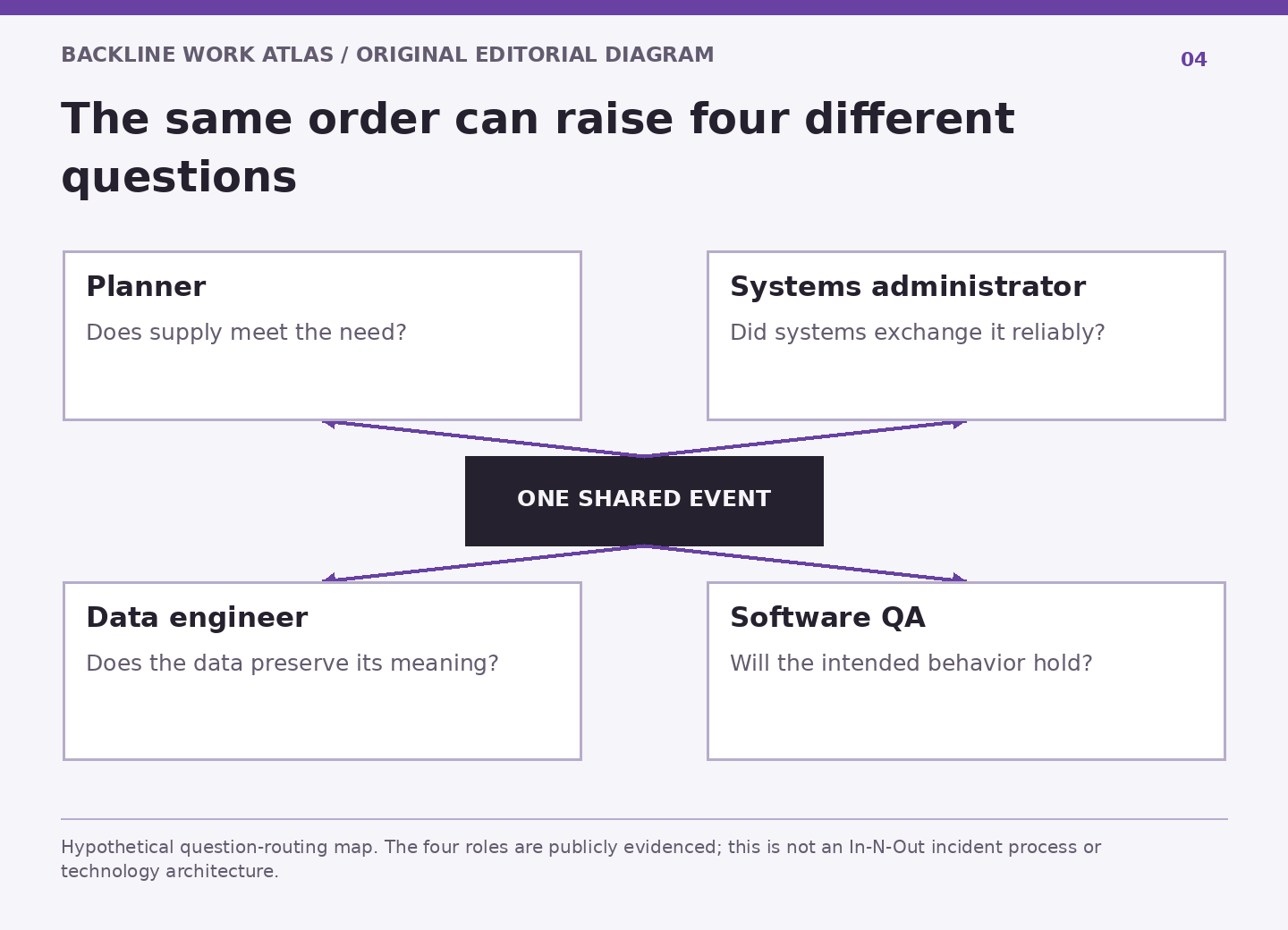
A planner’s first question might be whether the need was forty kits or forty cartons. A systems administrator’s question might be whether the record was transferred as intended. A data engineer’s question might be where the unit conversion is defined. A QA engineer’s question might be whether the application should display and validate the unit under the written requirement.
It would be premature to declare a single owner before clarifying the symptom. The same visible mismatch can contain more than one problem. The learning goal is to route questions with evidence, not to draw an organizational chart or imply that a specialist should work outside assigned authority.
For the exercise, produce a one-page incident summary containing the request reference, observed value and unit, expected value and unit, time of observation, impact and unresolved definition. Then mark which specialist question each field helps answer. You should be able to explain why a field is useful without naming a proprietary software tool.
The best practice artifact depends on the work family
For planning, build a small invented model that changes when demand or an arrival assumption changes. Explain the decision it supports and the assumption it cannot settle. For systems administration, draw an imaginary interface map and write a clear incident record; do not attempt access to a real system. For data engineering, create a tiny synthetic dataset with a documented transformation and validation checks. For software QA, define a harmless application’s expected behavior and test edge cases.
These are different deliverables. Reusing the same generic résumé exercise for every role would hide the differences that matter. The materials-planning case, data-lineage exercise and software quality guide each develop one output in more depth.
Do not overbuild. Ten traceable records can demonstrate more disciplined thinking than ten thousand unexplained rows. A short test report with a reproducible issue can be more informative than a screenshot of a green test dashboard. The aim is to expose your reasoning in a safe learning setting, not simulate insider experience.
Read the experience level as carefully as the technology list
The postings differ in required experience and education, and in which credentials are preferred. Those differences should drive preparation more than the apparent glamour of a technology name. A tool you recognize may be one small part of a role whose deeper requirement is years of independent work.
Also read location and work-arrangement statements in the current requisition. Technical work is not automatically remote, and an office title does not guarantee a standard weekday-only assignment. The observed systems-administration posting explicitly describes onsite work and a particular schedule; the other roles have their own terms. Recheck them rather than borrowing a condition from another opening.
End by choosing the question you want to become better at answering: “What should the plan be?”, “Why is this service failing?”, “What does this data mean?” or “Does the software behave as intended?” They overlap in practice, but separating them gives career exploration a concrete direction.
Sources and scope
Public sources checked October 4, 2026. Job pages are dated research snapshots; availability and requirements can change. Exercises are editorial examples.